
On this page
What does a new gutter system include?
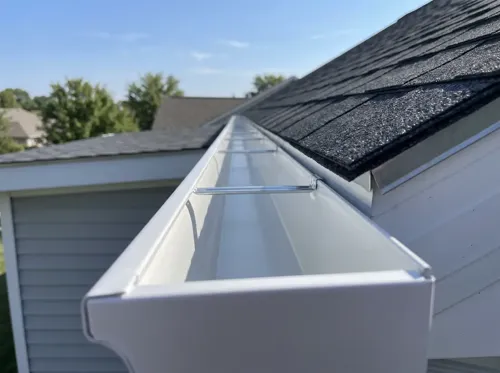
A gutter system is more than the trough. A complete installation covers everything from the roof edge to the place the water soaks in or drains away, and a quote should name each part.
| Part | What it does | What to look for in a quote |
|---|---|---|
| Drip edge or gutter apron | Metal flashing at the roof edge that sends water into the gutter, not behind it | Whether it is there, or will be added |
| Fascia | The board the gutter is fastened to | Probing for rot; replacement priced per foot |
| Gutter | The trough, usually K-style (ogee) or half-round | Size (5 or 6 inch), metal, thickness (.027 or .032 inch aluminum) |
| Hidden hangers | Screw-in brackets inside the gutter | Spacing, often 24 inches, closer under trees and ice |
| Miters | Corner joints: strip, box or hand-cut | How they are sealed and riveted |
| End caps | Closures at the run ends | Sealed and crimped |
| Outlets or drops | Holes where water leaves the gutter | Size matched to the downspout |
| Elbows (A and B style) | Bends that bring the downspout to the wall | Number per downspout |
| Downspouts or leaders | Vertical pipes, 2x3 or 3x4 inch | Count and size |
| Straps | Hold downspouts to the wall | Two or more per downspout |
| Extensions, splash blocks or drains | Carry water away from the foundation | Length and where they end |
How is a seamless gutter installed?
- Measure. The installer measures every run, notes each corner and outlet, and checks how much water each roof plane sends to each run.
- Check the roof edge. They look for a drip edge or gutter apron, probe the fascia and rafter tails for rot, and look for a hidden box gutter on older houses.
- Take down the old system. Spikes, ferrules, old hangers and downspouts come off, and the fascia is repaired or replaced where needed.
- Form the gutter. A roll-forming machine on a trailer shapes flat aluminum coil into one continuous length for each run.
- Snap the pitch. A chalk line sets a fall of about a quarter inch per 10 feet toward each outlet. Long runs are pitched both ways from the middle.
- Cut outlets and hang. Outlets are cut, the gutter is lifted into place and screwed through hidden hangers into the fascia.
- Miter and seal. Corners are mitered, riveted and sealed with gutter sealant; end caps are crimped and sealed.
- Run the downspouts. Elbows and downspouts are assembled, strapped to the wall and finished with extensions, splash blocks or a connection to a tested drain.
- Water test. A hose in each run shows whether water reaches the outlets and leaves the downspouts without backing up.
What size gutters does a house in Richmond need?
Most houses in the metro have 5-inch K-style gutters, and many do fine with them. The ones that overflow are usually steep two-story houses with long roof planes, hip roofs where several planes empty into one corner, and houses where a valley dumps a whole slope into a few feet of gutter. Those often need 6-inch gutters with 3x4 downspouts.
Richmond's normal year brings about 45.5 inches of precipitation, which is not extreme. What tests a gutter is the heavy day. During Gaston in 2004, the official gauge recorded 6.68 inches in 24 hours, and the downtown storm drains were overwhelmed. No residential gutter handles that, but one sized for a strong summer thunderstorm overflows far less in ordinary storms. See 5-inch vs 6-inch gutters.
| House | Typical size | Downspouts |
|---|---|---|
| One-story brick ranch in Lakeside, Highland Springs or Bon Air | 5-inch | 2x3 or 3x4, four to six |
| Two-story colonial in Short Pump, Glen Allen or Midlothian | 5-inch, 6-inch on the long back runs | 3x4, five to eight |
| Large hip-roof house with valleys | 6-inch | 3x4, with extra outlets near valleys |
| Fan or Church Hill rowhouse, rear ell | 5-inch half-round or K-style on the rear | 3-inch round or 2x3 |
| Historic house in Windsor Farms or Westover Hills | 5 or 6-inch half-round, sometimes copper | 3 or 4-inch round |
Which gutter material is best?
Aluminum is the default. It is light, does not rust, comes in dozens of baked-on colors and can be formed seamless on site. Ask for .032-inch coil if the house is under big trees or gets ice along the eaves. Copper costs several times as much and lasts decades, and the city's Commission of Architectural Review allows copper downspouts on masonry buildings in its historic districts. Galvanized and Galvalume steel are stronger than aluminum but rust where scratched. Vinyl is cheap but sags in summer heat and cracks in a freeze, and the commission treats it as inappropriate on historic buildings. See aluminum vs steel vs copper.
Installation types
- Seamless gutters: one piece per run, joints only at corners and outlets.
- 6-inch gutters: for large or steep roofs and long runs.
- Half-round gutters: for older and historic houses.
- Copper gutters: for masonry, historic and estate homes.
- Aluminum gutters: the standard choice.
- Downspouts: sizing, placement and drainage.
Local conditions an installer should plan for
Trees. Richmond's canopy covered 32 percent of the city in 2021, and its most important street tree by leaf area is the willow oak, followed by pin oak, red maple and sugar maple. Narrow oak leaves slip into gutters and mat at the outlets. Plan the outlets with a gutter guard in mind.
Ice. Snow is light most winters, but storms like the one in January 2026 bring snow, sleet and days below freezing. Hangers every 24 inches, or closer, keep the gutter from bending under ice.
Old houses. On houses built before about 1930, look for a built-in box gutter before hanging a new one. In the city's historic districts, the commission does not approve hung gutters where a box gutter exists. See box gutter repair.
Clay and slopes. Piedmont clay drains slowly, and many lots tilt toward the house or the alley. Downspout placement and extensions matter as much as the gutter. See downspouts and drainage in Richmond.
What to ask an installer
- What size and thickness of gutter are you quoting, and why that size for this roof?
- How many downspouts, what size, and where will each one discharge?
- What hangers, at what spacing, and screwed into what?
- Will you probe the fascia, and how is rotten wood priced?
- Is this house in a City Old and Historic District, and does the gutter match what is there?
- What is your Virginia license number and class?
See what gutters cost in Richmond for price ranges.