
On this page
What types of gutter guards are there?
Guards differ in how fine the openings are, how they are fastened and how they handle what falls on them. Matching the guard to the trees over your house matters more than the brand name.
| Type | How it works | Good for | Weak spots |
|---|---|---|---|
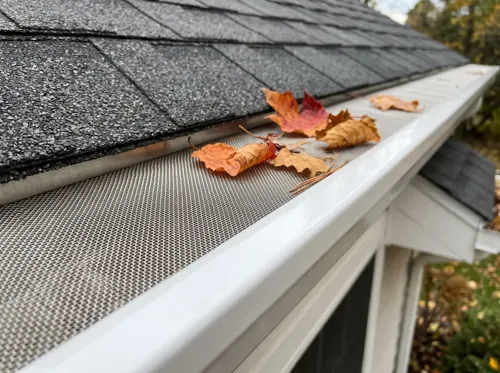
| Micro-mesh | Stainless steel mesh over an aluminum frame | Oak leaves, maple seeds, needles, gumballs | Pollen film; needs a brush-off now and then |
| Perforated aluminum cover | Solid sheet with punched holes | Large leaves | Small seeds and needles pass through or sit on top |
| Screen | Coarse metal or plastic grid | Big maple and tulip poplar leaves | Oak leaves and needles slip through |
| Reverse-curve | Water follows a curved nose into a slot | Large leaves, heavy rain | Visible from the street; seeds can enter the slot |
| Foam or brush inserts | Fills the gutter trough | Short-term fixes | Hold debris and moisture; break down |
Which guard suits Richmond's trees?
Richmond is a city of oaks and maples. The Virginia Tech street tree assessment found sugar maple, willow oak, crape myrtle, red maple and pin oak to be the most common street trees, with willow oak the most important by leaf area. Suburban lots in Henrico and Chesterfield add tulip poplars, sweetgums, white and red oaks, and loblolly pines.
| Tree | What it drops | What works |
|---|---|---|
| Willow oak | Narrow leaves in late fall, catkins in spring | Micro-mesh |
| Pin oak and red oak | Leaves that hang on into winter, acorns | Micro-mesh or a solid cover |
| Red and sugar maple | Big leaves in fall, winged seeds in spring | Micro-mesh; screens catch the leaves but not the seeds |
| Sweetgum | Spiky gumballs that jam outlets | Any mesh or cover |
| Tulip poplar | Large leaves, seed cones, sticky aphid drip | Micro-mesh |
| Loblolly pine | Needles year-round | Fine micro-mesh only |
How are gutter guards installed?
- Clean and inspect. The gutters are cleaned out, downspouts flushed, and hangers and pitch checked. Guards go on working gutters.
- Fix the gutter first. Loose hangers are replaced, sags re-pitched and leaking miters resealed.
- Fit the guard. Panels are cut to length, slid under the first course of shingles or set at the roof edge, and screwed to the gutter lip.
- Corners and valleys. Miters are cut to fit, and valleys, where water arrives fastest, get special attention so water does not overshoot.
- Test. A hose on the roof shows that water goes through the guard and not over it.
Are gutter guards worth it?
For most houses under big trees, yes. A house under willow oaks may need gutters cleaned twice each fall and again in spring, and every cleaning means a ladder at the eaves. A good guard cuts that to an occasional rinse and protects the outlets, which is where clogs cause overflow. The cost is higher up front; see are gutter guards worth it? for the trade-offs.
Guards are less useful on houses with few trees, on gutters near the end of their life, and on built-in box gutters, which need their own maintenance.
Guards and winter
Richmond's winters are mild most years, but storms like January 2026's left three to five inches of snow and sleet and a long stretch of ice. Snow can sit on a guard and freeze. A well-fitted guard on a properly pitched gutter drains meltwater as it thaws; a guard on a flat or sagging gutter traps it.
Options
What to ask about guards
- What mesh size and metal is it, and how is it fastened?
- Does it go under the shingles, and will that affect the roof warranty?
- What happens at valleys and corners?
- How will it be cleaned, and how often should I expect to?
- Is there a warranty against clogging, and what does it actually cover?