
On this page
- What does a downspout system include?
- How are downspouts placed and sized?
- Why discharge matters in Richmond
- Discharge options
- Richmond's stormwater credit
- Downspouts on historic houses
- Cost factors
- How many downspouts does a Richmond house really need?
- Where should a downspout go on the wall?
- Testing the whole path
What does a downspout system include?
| Part | Job |
|---|---|
| Outlet or drop | Where water leaves the gutter |
| Elbows (A and B style) | Turn the downspout back to the wall |
| Downspout or leader | The vertical pipe, 2x3, 3x4 or round |
| Straps | Hold the downspout to the wall |
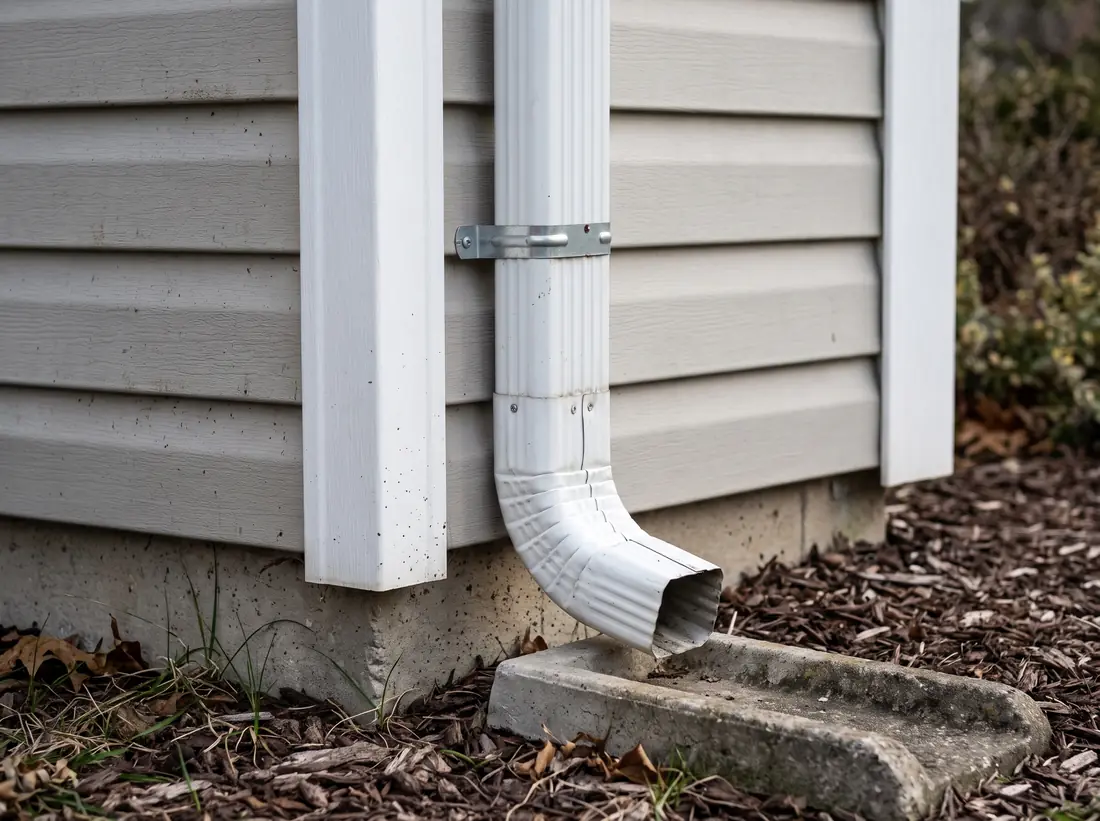
| Bottom elbow | Turns water away from the wall |
| Extension | Carries water further from the foundation |
| Splash block | Spreads water so it does not dig a hole |
| Underground drain | Buried pipe to a lower point |
| Cleanout | Access point for clearing a buried drain |
| Rain barrel diverter | Sends some water to a barrel, the rest down the spout |
How are downspouts placed and sized?
- Work out roof area draining to each gutter run, including valleys.
- Place outlets near valleys and at the ends of long runs.
- Choose size: 2x3 for small areas, 3x4 for larger ones and 6-inch gutters.
- Plan the discharge: where water will go at the bottom, given slope, soil, walks and neighbors.
- Strap the downspout at the top, middle and bottom.
- Fit the bottom with an extension, splash block, barrel or tested drain.
- Water-test from the gutter to the end of the drain.
Why discharge matters in Richmond
Clay soil. Much of the metro west of the Fall Line sits on Piedmont clay, which absorbs water slowly. Water dumped at a corner pools against the foundation. Henrico County's lot grading and drainage brochure tells homeowners to fit roof drains with downspouts that release water away from the home and to use splash pads at the end.
Slopes. Many lots, especially in older city neighborhoods and on the river bluffs, slope toward the house or toward a neighbor's yard. A downspout that empties onto that slope sends water where it causes trouble.
Old buried drains. Older houses often have downspouts that disappear into the ground through terra cotta or cast iron pipes. Some lead to the street, some to dry wells, and some to nowhere at all after decades of roots and settling. Test them before connecting new downspouts.
The sewer. About a third of the city, some 12,000 acres, is served by a combined sewer that carries stormwater and wastewater in the same pipe. In heavy rain it overflows to the James and Gillies Creek. A downspout piped into a sewer cleanout adds to that load; ask the city before connecting anything to a sewer.
Discharge options
| Option | When it works | Watch for |
|---|---|---|
| Splash block | Ground slopes away from the house | Erosion, water running back |
| Extension, 4 to 10 feet | Flat lots, short runs to a lawn | Mower damage, trip hazard |
| Flip-up or roll-out extension | Near walks and driveways | Must be put back down |
| Buried drain to daylight | Sloped lots with a lower outlet | Needs fall, cleanout and screen |
| Dry well | Sandy soil | Fills on clay soil; not for every lot |
| Rain barrel | Gardens, stormwater credit | Overflow must also go somewhere |
| Rain garden | Space downslope on the property | Size and plants matter |
Virginia Tech's extension guide to rooftop redirection describes sending downspout water to lawns, beds and gardens through extensions, including perforated pipe that lets water seep out along its length.
Richmond's stormwater credit
The city's stormwater utility offers fee credits for green practices on residential property. Its single-family credit manual lists rain barrels or other storage with at least 50 gallons per downspout, covering at least half the roof area, with a lid or screen against mosquitoes. A single practice earns a 20 percent credit, and combined practices up to 50 percent. See rain barrels and the stormwater credit.
Downspouts on historic houses
In City Old and Historic Districts, the Commission of Architectural Review treats rectangular and vinyl downspouts as inappropriate on historic buildings. Round downspouts, painted to match the body or trim, are the usual answer; copper is allowed on masonry.
Cost factors
- Number and length of downspouts
- Size: 2x3, 3x4 or round
- Extensions and splash blocks
- Buried drains, cleanouts and pop-up emitters
- Rain barrel diverters
- Masonry anchors on brick
See downspout repair and downspouts and drainage in Richmond.
How many downspouts does a Richmond house really need?
More than many builders install. A rule of thumb is one downspout for every 30 to 40 feet of gutter, but roof shape matters more than length. A run below a valley may need its own downspout even if it is short. A long rear run on a two-story colonial in Short Pump or Midlothian usually needs one at each end. Adding a downspout is often the cheapest fix for overflow.
Where should a downspout go on the wall?
| Placement | Good | Avoid |
|---|---|---|
| House corners | Natural and unobtrusive | Corners where the ground slopes back toward the wall |
| Near valleys | Shortest path for concentrated water | Behind shrubs where it cannot be cleaned |
| Beside walks and drives | Convenient for buried lines | Discharging across a walk where it can freeze |
| Back of the house | Out of sight | Into a window well or onto a patio that slopes to the house |
Testing the whole path
After installation, run water at the top of each run and follow it all the way down and out. Water should leave the gutter without backing up, travel the downspout without leaking at elbows, and leave the extension or drain without coming back toward the house. A five-minute test catches most mistakes.