
On this page
- Why half-round on Richmond's older houses?
- What parts make up a half-round system?
- How are half-round gutters installed?
- Half-round and the historic districts
- Which material?
- Where half-round shows up in the metro
- Capacity and sizing
- Cost factors
- How do you keep half-round gutters looking right?
- Half-round and leaves
- Replacing K-style with half-round
Why half-round on Richmond's older houses?
Until the K-style profile spread in the mid-20th century, most hung gutters were half-round. A large share of Richmond's houses were built before then. The Fan was built mostly between the Civil War and about 1920, the Museum District between 1895 and 1940, and streetcar suburbs such as Woodland Heights mostly between 1895 and 1935. On a Victorian, Colonial Revival, Tudor or Craftsman house, half-round gutters and round downspouts are part of the original look.
What parts make up a half-round system?
| Part | Half-round version |
|---|---|
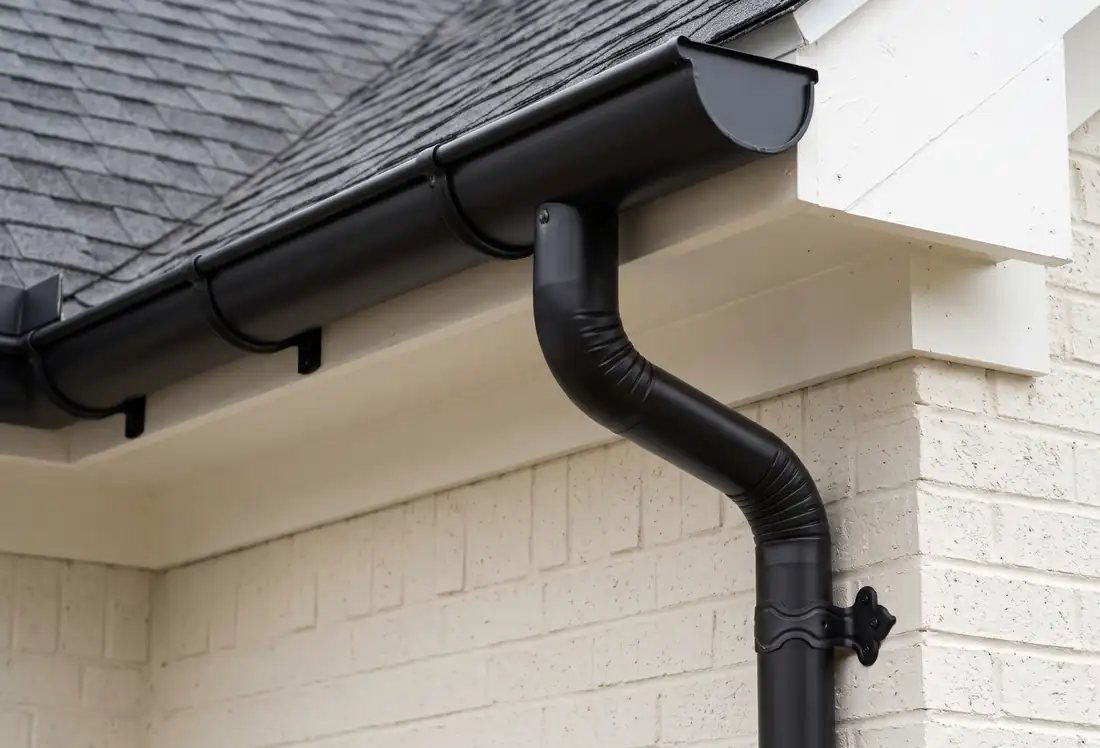
| Gutter | 5, 6 or 7-inch half-round with a front bead (single or double) |
| Hangers | Shank and ferrule, roof-strap, or decorative brackets |
| Outlets | Round drop outlets |
| Downspouts | 3 or 4-inch round, plain or corrugated |
| Elbows | Round, 45 or 75 degree |
| Straps or hooks | Decorative downspout hooks into masonry |
| End caps | Round, soldered or sealed |
| Joints | Lap seams, soldered on copper |
How are half-round gutters installed?
- Measure each run and decide hanger type and spacing.
- Set the hangers at the pitch line; brackets are bent or adjusted to set the fall.
- Lay in the gutter lengths, lapping and sealing or soldering the seams.
- Fit outlets and end caps, soldered on copper or sealed on aluminum.
- Attach round downspouts with elbows and hooks or straps.
- Water test and adjust brackets where water stands.
Half-round and the historic districts
In a City Old and Historic District, the Commission of Architectural Review's gutter guidelines let staff approve in-kind replacement that matches the existing profile and uses a comparable material. They treat K-style as an inappropriate profile on historic buildings, vinyl and synthetic materials as inappropriate, and rectangular downspouts as inappropriate. They also allow copper downspouts on masonry buildings. Half-round with round downspouts is the usual answer on a historic house that already has hung gutters.
Where a house has a box gutter built into the cornice, the guidelines go further: the commission does not approve hung gutters in place of a box gutter. See box gutter repair and gutters in Richmond's historic districts.
Which material?
| Material | Pros | Cons |
|---|---|---|
| Copper, 16 or 20 oz | Lasts decades, soldered seams, weathers naturally | Highest cost; stains masonry green below if unmanaged |
| Aluminum | Light, affordable, many colors | Seams are sealed, not soldered; dents more easily |
| Galvalume or galvanized steel | Strong, can be painted | Rusts at cuts and scratches |
| Zinc | Long-lived, matte gray | Specialist installers; higher cost |
Where half-round shows up in the metro
- Windsor Farms, laid out in 1926, with Colonial Revival and Tudor houses.
- Westover Hills, laid out in 1928 with Georgian and revival styles.
- Forest Hill, a trolley suburb of Queen Anne, Colonial Revival, Craftsman and Tudor houses.
- Ginter Park, one of Richmond's first streetcar suburbs, listed in 1986.
- Bon Air, the Victorian resort village founded in 1877.
Capacity and sizing
Half-round holds less water than K-style of the same width, so contractors usually go up one size: 6-inch half-round where a 5-inch K-style would do. On steep roofs or under valleys, 7-inch half-round is not unusual.
Cost factors
- Material (aluminum, copper, steel, zinc)
- Size and number of seams
- Hanger type, especially decorative brackets
- Round downspout length and fittings
- Work on masonry: hooks drilled into brick
- Height and access
See copper gutters and aluminum vs steel vs copper.
How do you keep half-round gutters looking right?
Half-round gutters are seen as well as used. Brackets should sit at an even spacing, the bead should run straight along the eave, and downspouts should drop plumb and be held with hooks or straps that suit the wall. On brick, contractors drill into mortar joints rather than the brick face where possible, so holes can be repaired later.
Half-round and leaves
The rounded trough sheds debris a little better than a flat-bottomed K-style, but it still clogs under oaks. Micro-mesh guards are made for half-round, though the selection is smaller than for K-style. Outlet strainers in each drop are a simple alternative on houses where guards would spoil the look.
Replacing K-style with half-round
Many older Richmond houses lost their half-round gutters to K-style replacements in the mid-20th century. Going back to half-round is common in restorations. It usually means new brackets, round outlets and round downspouts, and sometimes fascia repair where the old K-style hangers left holes. In a City Old and Historic District, replacing an inappropriate suspended gutter with an appropriate one can be approved by staff where no box gutter is present, under the commission's guidelines.