
On this page
Screen guards
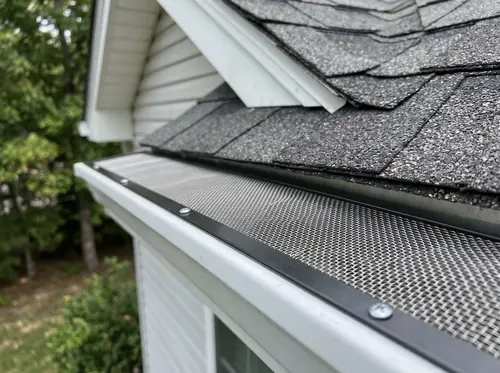
A screen guard is a grid of metal or plastic laid over the gutter. It is the oldest and cheapest kind of guard. Its openings are large enough that water pours straight through, but so do small leaves, seeds and needles.
| Pros | Cons |
|---|---|
| Inexpensive | Narrow oak leaves pass through |
| Easy to install | Seeds and needles pass or stick |
| Good with big leaves | Plastic versions warp and crack |
| Handles heavy rain | Needs regular brushing |
Reverse-curve guards
A reverse-curve (or surface-tension) guard is a solid aluminum hood that covers the gutter, with a curved front nose. Water follows the curve around and drops into a slot; leaves slide off.
| Pros | Cons |
|---|---|
| Sheds large leaves well | Visible from the street, changes the look of the eave |
| Solid, resists limbs | Seeds and needles can enter the slot |
| Handles moderate rain | Can overshoot on steep roofs in heavy rain |
| Long-lasting metal | Harder to clean when the slot clogs |
How are they installed?
- Clean and repair the gutters first.
- Fit the back edge under the shingles or at the roof edge.
- Fasten the front to the gutter lip with screws or clips.
- Join panels and fit corners.
- Water test, especially at valleys on reverse-curve systems.
How they suit Richmond trees
| Tree | Screen | Reverse-curve |
|---|---|---|
| Willow oak | Leaves pass through | Leaves slide off; catkins can enter slot |
| Red or sugar maple | Leaves stay out; seeds pass | Leaves slide off; seeds can enter |
| Tulip poplar | Leaves stay out | Leaves slide off |
| Sweetgum | Gumballs stay out | Gumballs roll off |
| Loblolly pine | Needles pass or stick | Needles can enter slot |
Richmond's most important street tree by leaf area is the willow oak, with its narrow leaves. That is the main reason fine micro-mesh has become the more common choice here.
When to choose them
- Screen: a budget fix on a house with mostly big-leaf trees, or a rental where a simple guard beats none.
- Reverse-curve: a solid look is wanted, roof pitch is moderate, and the trees are mostly big-leaf.
- Neither: houses under pines or willow oaks, steep roofs, box gutters, and historic houses where the look of the eave matters.
Historic houses
A reverse-curve hood changes the line of the eave. On a historic house in a City Old and Historic District, the Commission of Architectural Review looks at elements that detract from the roof or cornice line; ask the city before adding a visible hood.
Maintenance
- Brush screens after the main leaf drop.
- Check reverse-curve slots and clean with a thin brush.
- Flush downspouts once a year.
- Check fasteners after storms.
See gutter guards and are gutter guards worth it?.
Why do some guards make cleaning harder?
A coarse screen stops big leaves but lets small debris through. That debris settles in the gutter underneath, where it is now harder to reach because the screen is in the way. Reverse-curve guards can collect seeds and needles inside the slot, out of sight until the gutter overflows. Either way, a guard that lets fine debris in can mean less frequent but more awkward cleaning.
Matching the guard to the house
| House | Better choice |
|---|---|
| One-story, maples and tulip poplars | Metal screen or perforated cover |
| Two-story under willow oaks | Micro-mesh |
| Under loblolly pines | Fine micro-mesh |
| Moderate roof pitch, big-leaf trees, wants a solid look | Reverse-curve |
| Historic house in a city district | Low-profile mesh, or none |
What to avoid
Foam and brush inserts are sold as easy fixes. In a humid climate like Richmond's, foam holds water and fine debris and can grow plants; brushes trap leaves that then have to be pulled out. They are rarely worth it beyond a short-term stopgap.