
On this page
Common downspout problems
| Problem | Sign | Repair |
|---|---|---|
| Clogged elbow | Overflow at the outlet, dry downspout | Clear and flush; consider larger downspouts or guards |
| Clogged outlet | Water stands over the drop | Clear; add a strainer or guard |
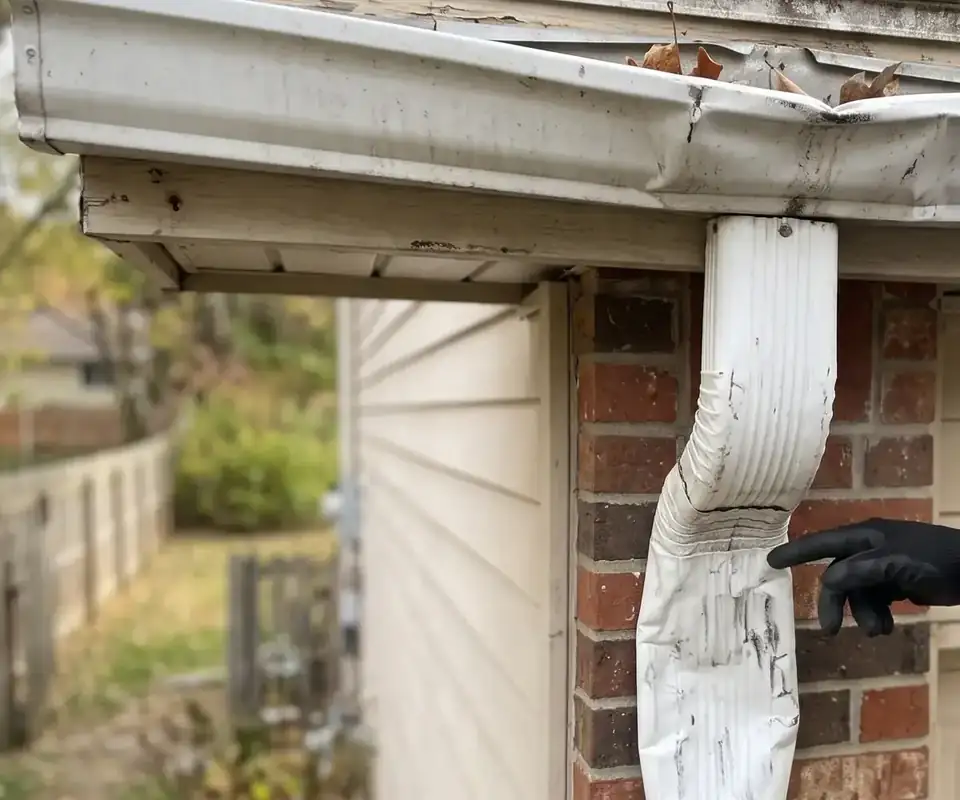
| Crushed bottom section | Flattened pipe, water sprays out | Replace section; add a flip-up extension |
| Loose straps | Downspout swings away from wall | Re-strap into solid backing |
| Disconnected joint | Water sprays from a seam | Re-seat, screw and seal |
| Missing extension | Water digs a hole at the foundation | Add extension or splash block |
| Failed buried drain | Water backs up out of the pipe or appears in the basement | Test, clear, repair or replace the drain |
How is a downspout repaired?
- Run water into the gutter at the outlet and watch where it goes.
- Clear clogs from the top, through the elbows, with a plumber's snake or water.
- Replace damaged sections and elbows, fastening joints with screws.
- Re-strap at the top, middle and bottom.
- Test buried drains with a hose; check the outlet end and use a camera if needed.
- Fix the discharge with an extension, splash block or new drain to a lower point.
- Water test the whole path.
Downspouts and wet basements in Richmond
A large share of Richmond-area houses have basements or crawlspaces, and much of the region sits on clay that drains slowly. A downspout that empties at the foundation concentrates a whole roof's water on a few square feet of soil against the wall. That water does not go far.
Henrico County's lot grading and drainage brochure tells homeowners to make sure roof drains release water away from the home, and the county's stormwater guidance suggests directing downspouts away from paved surfaces and into a rain garden where possible. Henrico has also said that thousands of homes in the county have drainage problems, beyond those in mapped floodplains.
Old buried drains
On houses built before the 1960s, downspouts often run into terra cotta or cast iron pipes below grade. Over decades, roots, settling and debris block them, and a blocked buried drain fills and backs water out at the joint near the foundation, exactly where it does most harm.
| Test | What it shows |
|---|---|
| Hose test | Whether water comes out the other end, and how fast |
| Listen at the joint | Gurgling or backing up near the wall |
| Camera | Breaks, roots, crushing |
| Dig at the downspout | Whether the pipe is intact just below grade |
If a drain cannot be cleared, the simplest fix is often to abandon it, cap it, and run the downspout above ground to an extension or a new drain.
Downspouts and the city sewer
About a third of Richmond is served by a combined sewer, which carries stormwater and wastewater together and overflows into the James and Gillies Creek in heavy rain. A downspout piped into a sewer cleanout or floor drain adds rainwater to that system. Ask the city before connecting anything to a sewer. Route it to the ground instead, or to a rain barrel.
Cost factors
- Number of downspouts and sections replaced
- Depth and length of buried drains
- Camera inspection
- New drain lines, cleanouts and emitters
- Masonry anchors on brick walls
See downspouts and downspouts and drainage in Richmond.
How do you clear a clogged downspout?
Start at the top. Clear the outlet in the gutter by hand, then run a hose down the downspout. If water backs up, the clog is usually at the first elbow. Tapping the elbow while the water runs can free it; if not, the elbow can be unscrewed and cleared. For long or buried runs, a plumber's snake fed from the bottom works. Avoid pressure washers, which can split seams.
Downspouts that disappear underground
| What you find | What it may mean |
|---|---|
| Water bubbles out at the joint near the ground | Buried pipe blocked or collapsed |
| Wet patch in the lawn along a line | Broken pipe leaking along its route |
| No outlet anywhere | Pipe ends in a dry well, or goes nowhere |
| Outlet at the curb runs clear | Pipe is working |
Simple upgrades
- Swap 2x3 downspouts for 3x4 where clogs are frequent.
- Add a cleanout at the base of buried runs.
- Replace a crushed bottom section with a flip-up hinge extension near driveways.
- Fit outlet strainers where trees overhang.